Production Solutions: Software UX Update
The Problem
Production Solutions planned a major update to its internal data and project management platform, ProSIS, as part of a multi-year modernization effort. The team needed to understand which existing features users relied on most and which improvements would deliver the greatest value without disrupting established workflows or institutional knowledge.
Production Solutions is a mid-sized information services company supporting non-profit organizations with operational data, reporting, and project management tools. At the time of research, ProSIS supported 200+ active client organizations and was used internally by approximately 40–60 account managers.
Each account manager typically supported 5–12 nonprofit clients simultaneously, managing overlapping timelines, budgets, and deliverables for organizations with limited technical resources. Most users were experienced professionals (often 5–15+ years in role) who relied on ProSIS daily and prioritized speed, accuracy, and confidence over customization.
The Plan
I partnered with a business analyst to design a series of moderated focus groups aimed at capturing both aspirational feedback and concrete usability concerns. The goal was to understand how ProSIS fit into users’ real workflows before evaluating individual features or interface elements.
Research Methodology
Three moderated focus group sessions
4-5 participants per session
Participants aligned to the account manager persona (primarily ProSIS users)
These sessions combined open-ended discussion with feature prioritization exercises included card sorting and labeling annotated screenshots
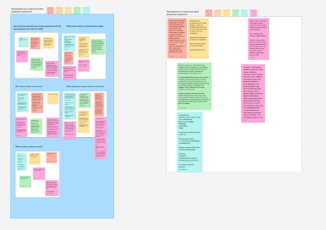
Screenshot from results of focus group
Focus groups for this project were open-ended, asking users how they would rebuild ProSIS from scratch if they “walked into work tomorrow and it was completely gone.” This enabled us to identify the most crucially beneficial features of ProSIS and the features users would most like to change.
The Results
Key Findings
“All-in-one” power creates usability friction
ProSIS is trusted as a system of record, but its breadth leads to navigation overload, repeated manual steps, and high onboarding costs.Strong desire for AI as a workflow partner
Users framed AI as a way to reduce setup time, reuse historical knowledge, surface risk, and guide prioritization.Preference for fewer decisions, not more controls
Repeated calls for templates, predictive modeling, and clear status indicators.Lack of visual hierarchy
When everything appears equally important, users compensate with memory and experience.
The findings informed feature prioritization discussions for the ProSIS roadmap and helped shape early thinking around workflow guidance and intelligent assistance in future iterations.